Mastering Perplexity AI Search: How Canadian Businesses Get Cited, Recommended, and Found in 2026

Most Canadian business owners have never heard of PerplexityBot. That is exactly the problem. While they have been focused on Google rankings, a citation-first search engine has quietly grown to 45 million monthly active users, is processing more than 780 million queries per month, and is now powering the default AI search inside Snapchat’s platform of nearly one billion users. Perplexity AI is not the future of search. It is the present, and the businesses being cited inside its answers right now are earning a compounding visibility advantage their competitors do not yet realize they are losing.
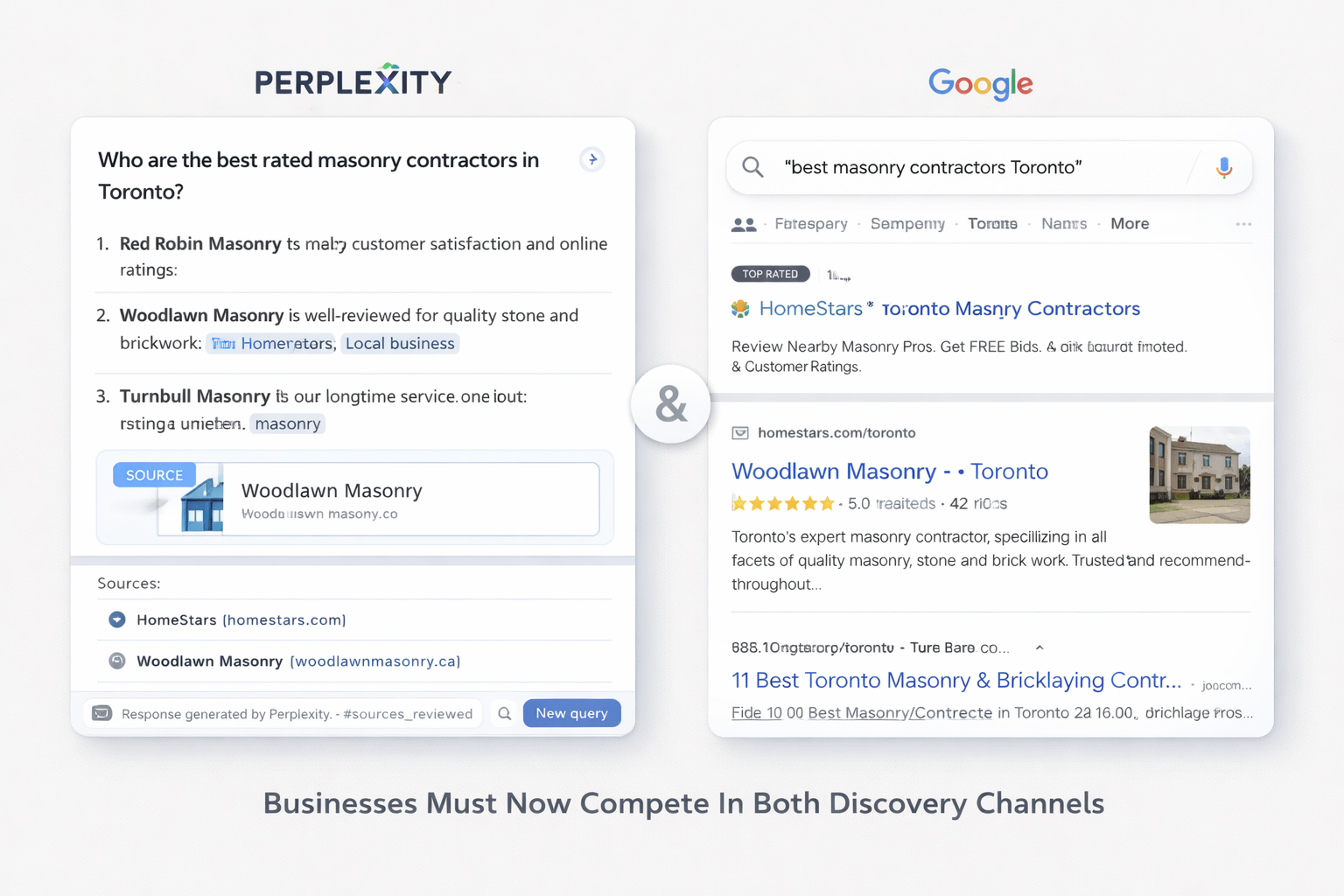
Perplexity operates on a fundamentally different model than every search tool that came before it. It does not show a list of links and ask users to choose. It reads the available sources, synthesizes the best answer, and displays its citations directly alongside the response. When your brand is one of those citations, you are not just a result. You are the recommendation. You are the verified answer. And the users who arrive at your website from that citation are arriving pre-convinced, having already been told by an AI that you are worth their time.
This is why Perplexity AI search optimization has become one of the most high-leverage investments in digital marketing for 2026. It is a first-mover environment. Most of your competitors have not built for it yet, which means the cost of entry is lower today than it will be in twelve months.
For a broader look at how Perplexity fits into the full AI search landscape, read our guide to SEO trends in 2026 and how to rank across every major AI search engine.
Perplexity AI search optimization is the practice of structuring your website’s content, technical architecture, and brand authority so that Perplexity’s retrieval-augmented generation system selects, summarizes, and cites your brand when answering questions your ideal customers are asking.
This guide covers the full picture:
- Why Perplexity Demands Your Attention Now: The platform growth numbers that make it impossible to ignore in 2026.
- How Perplexity Actually Works: Understanding its RAG system and why it is nothing like optimizing for Google.
- The Exact Tactics That Earn Citations: What Perplexity’s algorithm rewards, from content structure to domain authority to recency signals.
A Measurable Framework: How to audit your current Perplexity visibility, execute optimization, and track your results over time.
Critical Perplexity AI Facts for Canadian Businesses in 2026
| What You Need to Know | How It Affects You |
|---|---|
| 45 million monthly active users and growing | Perplexity’s user base grew 100% year-over-year from early 2025 to late 2025. The platform is no longer a niche tool for tech enthusiasts; it has crossed into mainstream professional and consumer use. |
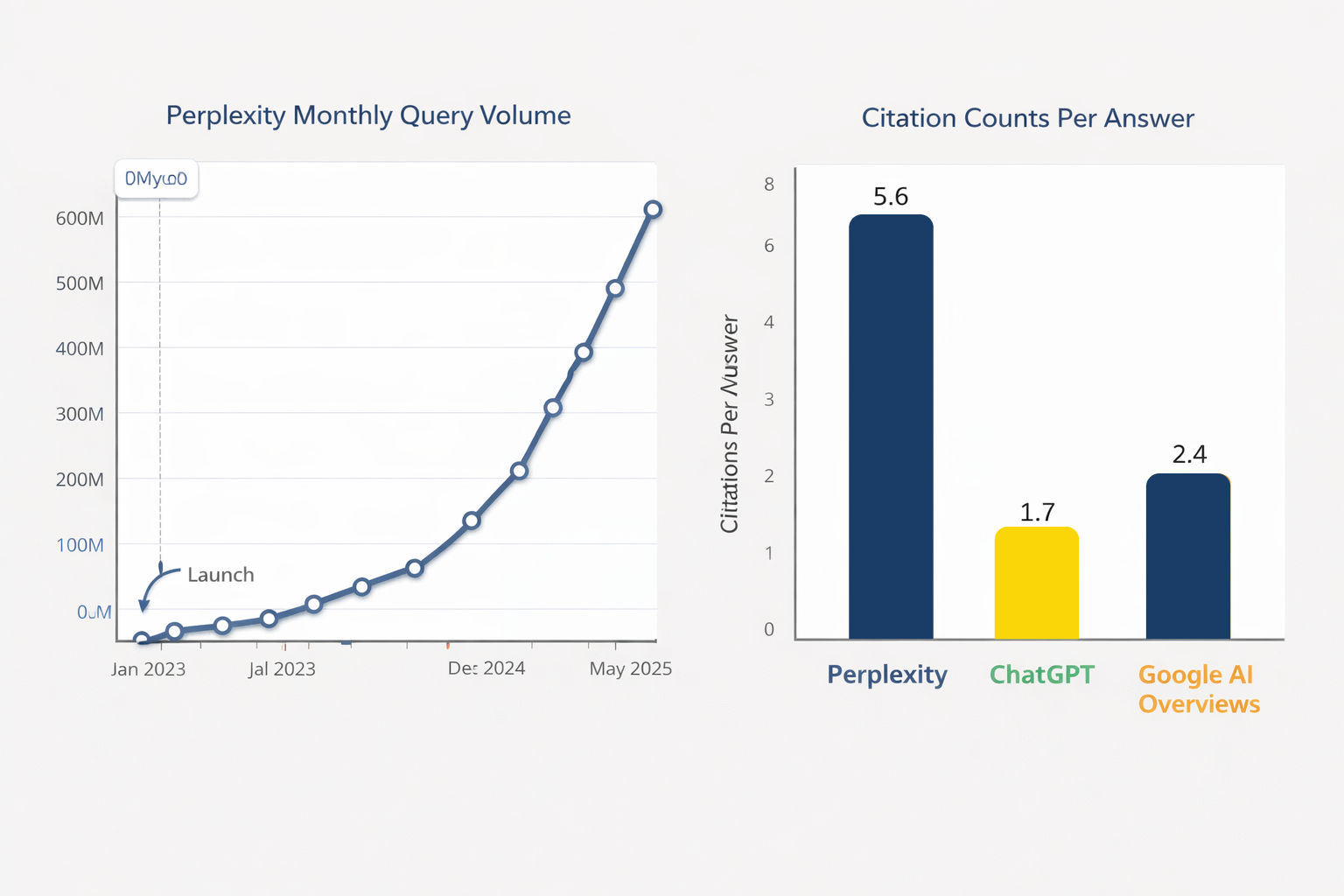
| 780 million queries processed in May 2025 alone | That represents a 239% increase in query volume from August 2024. The platform is scaling at a rate that makes early optimization decisions disproportionately valuable. |
| Perplexity shows 6 to 8 citations per answer | Compare this to ChatGPT’s typical 3 to 4 citations. More citation slots means more opportunity for your brand to appear. The question is whether your content is structured to be selected. |
| Average session duration exceeds 12 minutes | Perplexity users are not browsing. They are conducting research. Nearly 48% of all sessions extend beyond 15 minutes, meaning the people finding your brand through Perplexity citations are among the most engaged, purchase-ready audiences in digital search. |
| Only 11% of domains cited in Perplexity also appear in ChatGPT citations | The two platforms draw from largely separate source pools. Winning in one does not automatically transfer to the other. Platform-specific optimization is necessary, not optional. |
| Brands cited in Perplexity see 3 to 4 times higher brand recall | Early data shows that Perplexity citations produce 40% lower customer acquisition costs than traditional paid search. The AI’s endorsement carries a trust signal that paid placements cannot replicate. |
The Strategic Methodology Framework for Perplexity AI Optimization
1. Understanding How Perplexity Thinks and Selects Sources
Perplexity is not a search engine in the traditional sense. It is an answer engine built on a retrieval-augmented generation, or RAG, architecture. When a user submits a query, Perplexity does not return a ranked list of pages. It scans live web sources in real time, evaluates their credibility and structural clarity, synthesizes the information, and constructs a direct answer. It then displays the sources it cited so users can verify the response.
This changes the competitive dynamic entirely. You are not competing for a position on a results page. You are competing to be selected as one of the six to eight sources an AI chooses to build its answer from. That selection is based on a combination of domain authority, content structure, recency, topical depth, and factual verifiability. Generic, keyword-stuffed content that has performed adequately in traditional Google rankings is almost never selected by Perplexity. The bar for citation is genuinely higher, but the reward for clearing it is also dramatically higher.
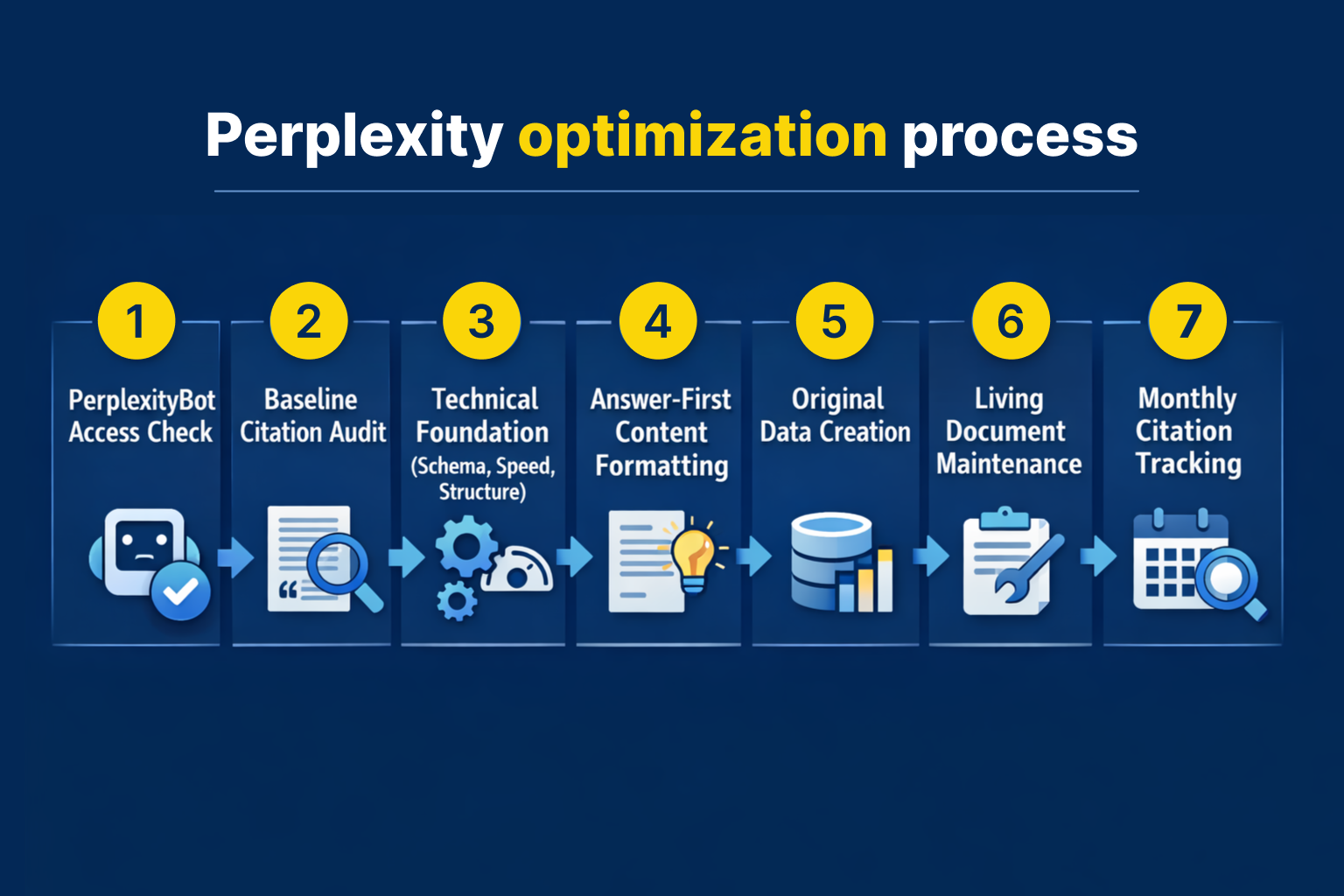
The foundation of any Perplexity optimization strategy is a baseline audit. Before changing a word of content or a line of code, you need to know where your brand currently stands. The process is straightforward: identify your 30 to 50 most strategically important queries, run them through Perplexity in a clean browser environment, and document whether your brand appears, how prominently it is cited, which competitors are being referenced instead, and what types of sources Perplexity is drawing from. This audit gives you the competitive intelligence to prioritize your efforts correctly from day one.
One of the most important technical details that most Canadian businesses have overlooked is PerplexityBot itself. Perplexity’s web crawler, PerplexityBot, must be able to access your site for your content to be considered as a citation source. Check your robots.txt file and ensure it does not inadvertently block PerplexityBot or Perplexity-User agent strings. If your site is blocking the crawler, your content does not exist in Perplexity’s universe, regardless of how well-written it is.
2. Building the Technical Foundation Perplexity Rewards
Perplexity’s Sonar ranking model strongly favours content that already ranks well in Google’s organic results. This is the most important structural fact about the platform: strong traditional SEO is the prerequisite for Perplexity citation, not an alternative to it. The foundational work of technical SEO that improves your Google rankings directly improves your eligibility for Perplexity inclusion. A technically sound, fast-loading, mobile-responsive website with clean internal architecture is not just a Google requirement. It is a Perplexity requirement.
Beyond the traditional SEO foundation, several technical elements are specifically weighted by Perplexity’s algorithm. Schema markup is one of the highest-impact implementations available. FAQPage schema, HowTo schema, Article schema with dateModified and author fields, and Organization schema all help Perplexity’s system understand what your content represents, who created it, and how current it is. Perplexity strongly favours recent content and accurately timestamps its sources. If your schema markup does not include a current dateModified value that reflects genuine content updates, the platform’s recency filter will deprioritize your content in favour of more recently updated pages covering the same topic.
Content structure is the technical layer that most directly influences whether Perplexity can extract and cite your content. Every page you want cited should follow a clear H1, H2, H3 hierarchy. Sections should open with a direct answer in the first sentence, followed by supporting detail. Short sentences of twenty-five words or fewer, active voice, and clear semantic labeling make content easy for the RAG system to parse. Perplexity evaluates extractability: if your answer is buried in the fourth paragraph under a lengthy introduction, the AI assigns it a lower confidence score and moves on to a competitor’s page that leads with the answer.
3. The Content Tactics That Drive Perplexity Citations
Perplexity favours data-driven, research-based content. This is a meaningful distinction from ChatGPT, which tends toward conversational and how-to formats. When you are writing specifically to earn Perplexity citations, you are writing for an audience of one: an AI system that is looking for the most structured, factually verifiable, and authoritatively sourced content available on a given topic.
Tables and structured comparisons are among the most powerful citation triggers on Perplexity. When a user asks a comparison query, Perplexity’s system looks for clean HTML table data it can extract directly into its answer. A page that presents a comparison in flowing prose is harder to cite than a page with a clearly labeled table. This is a format change that can be implemented quickly across your highest-priority pages and can produce measurable citation improvements within weeks.
Original data is treated as citation gold. Perplexity’s algorithm weights proprietary research, original statistics, and documented first-hand outcomes significantly higher than content that restates information available elsewhere. If your business can publish even a modest original data point, such as an analysis of your own client outcomes, an internal survey, or a documented industry observation drawn from your own practice, that data becomes a citable asset that AI systems will return to repeatedly. Content that simply paraphrases other sources gives Perplexity no reason to select you over the source you are paraphrasing.
Recency is one of Perplexity’s most heavily weighted ranking factors. The platform actively filters for current information and assigns a form of content decay, where older pages lose citation priority over time unless they are actively updated. The most effective approach is the “Living Document” strategy: maintain your core pillar pages as continuously updated resources rather than static articles. Add a “Recent Updates” block near the top of high-priority pages noting what has changed and when. Ensure your schema markup reflects the actual dateModified value. This signals to Perplexity’s system that your content is maintained and authoritative rather than abandoned.
Topic cluster architecture reinforces the topical authority signals Perplexity uses to evaluate domain credibility. Perplexity’s memory networks connect related content and assess whether a domain has genuine depth on a subject or only surface-level coverage. A site with a strong central pillar page supported by multiple in-depth articles on related subtopics signals deep expertise. A site with a single isolated article on a topic, regardless of how well-written it is, carries less weight than a competitor whose entire content ecosystem demonstrates comprehensive mastery of the subject.
4. Building Brand Authority That Perplexity Trusts
Domain authority accounts for approximately 15% of Perplexity’s ranking factors, making it the single largest weighted signal outside of content quality itself. This means your off-page SEO investment, the backlinks, brand mentions, and third-party publications that reference your business, directly influences your Perplexity citation frequency. Perplexity is selective about its sources precisely because it displays them publicly. When users see a citation, they see the brand. Perplexity’s credibility is tied to the credibility of the sources it recommends, which means it applies a genuine editorial filter that keyword-based ranking cannot override.
Building the authority Perplexity respects requires investment in what is sometimes called digital PR. Being referenced by credible publications in your industry, appearing in industry reports, earning contributions or mentions on authoritative platforms, and maintaining an accurate and complete presence across business directories all contribute to the authority signals Perplexity evaluates. One marketing agency that engineered Perplexity visibility for their own brand reported a 4,162% increase in organic traffic and secured the number one citation position in Perplexity for their core category in just twenty days, driven primarily by a concentrated authority-building campaign.
Specialized Pillars of Excellence for Perplexity AI Optimization
The Role of an Authoritative Brand Presence
Perplexity publicly displays its sources. This is not a minor feature. It is the defining characteristic of the platform’s value proposition. Users choose Perplexity specifically because they want verified, cited answers rather than anonymous AI-generated text. This transparency means that every brand Perplexity cites is being implicitly endorsed in front of a highly engaged, research-oriented audience.
The trust signals Perplexity uses to evaluate brand authority mirror Google’s E-E-A-T framework: Experience, Expertise, Authoritativeness, and Trustworthiness. Content attributed to identified authors with verifiable credentials, linked LinkedIn profiles, relevant industry certifications, and a consistent publishing history receives preferential treatment. Anonymous content, content without clear authorship, and content from domains with thin or inconsistent histories are systematically deprioritized. For Canadian businesses, this means every substantive piece of content published should carry a real author identity with real credentials. The investment in author authority pays dividends across every AI search platform simultaneously.
Market Visibility and Relevance: Timing Your Perplexity Presence
Perplexity’s recency bias creates a specific strategic opportunity that does not exist in the same way on Google. On Google, a well-established page with strong backlinks tends to hold its ranking for extended periods. On Perplexity, a newer page with a stronger recency signal can outperform an older, higher-authority page if it is more current and more structured. This means businesses that act on Perplexity optimization now, before the platform becomes as competitive as Google, can earn citation positions that would require years to achieve in traditional search.
The platform’s growth trajectory makes the timing argument even more compelling. Perplexity processed 500 million total queries across all of 2024. It processed 780 million queries in May 2025 alone. By mid-2026, projections suggest the platform will process between 1.2 and 1.5 billion queries per month. The brands that are already being cited when that growth arrives will be vastly more entrenched than brands that begin optimizing after the competition recognizes the opportunity.
Analyzing Engagement and Behaviour on Perplexity
The users who find your brand through Perplexity are qualitatively different from the users who find you through a broad Google search. Perplexity’s average session duration exceeds twelve minutes, and nearly half of all sessions extend beyond fifteen minutes. These are not casual browsers. They are researchers, decision-makers, and buyers who are conducting serious evaluation before taking action. When they encounter your brand as a cited source inside a Perplexity answer, they have already been told by a trusted system that you are an authoritative voice on the topic.
This translates directly into conversion behaviour. Traffic from Perplexity arrives with purchase intent that is already partially formed. Studies comparing AI-referred traffic to traditional organic search traffic show that AI-referred visitors are 4.4 times more valuable on average, because their initial research phase is already complete. They are not asking introductory questions. They are looking for confirmation that the brand the AI recommended is the right choice. Your website’s job, for a Perplexity-referred visitor, is validation, not introduction.
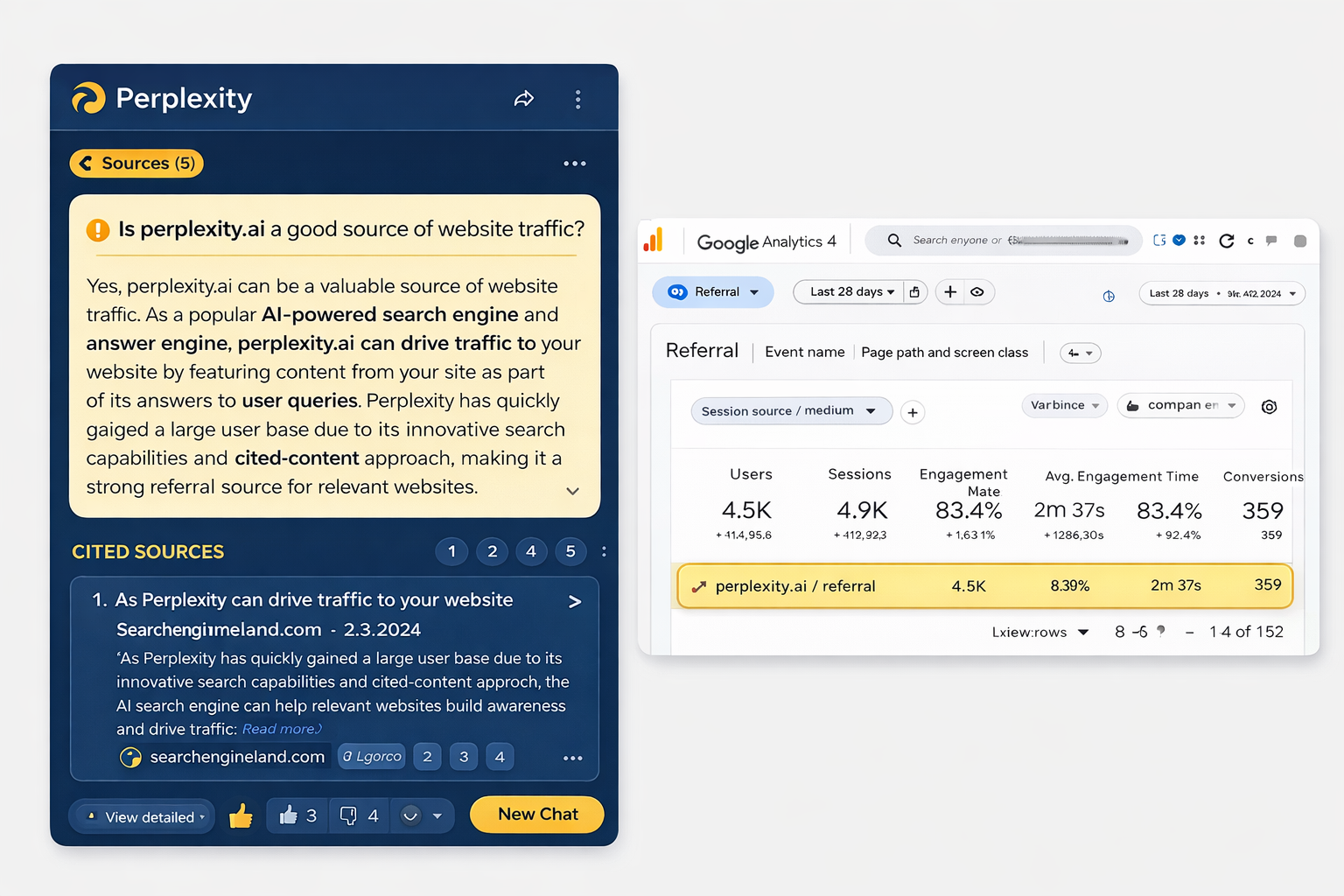
Tracking Perplexity referral traffic is straightforward. The platform appears as “perplexity.ai” in your referral sources within Google Analytics 4. Setting up a custom segment specifically for Perplexity referrals allows you to track conversion rates, session behaviour, and revenue attribution from this channel separately, giving you a clear view of the return your optimization investment is generating.
Reaching High-Intent Segments Through Perplexity-Specific Content
The query types that drive Perplexity usage skew heavily toward research and comparison intent. Users are asking questions like “What is the best digital marketing agency in Toronto for home services businesses?” and “Compare SEO approaches for Canadian small businesses in competitive markets.” These are not the short, ambiguous queries that dominated traditional SEO strategy. They are the kinds of questions asked by people who are close to a decision and looking for a trusted, authoritative answer.
Content built specifically for these high-intent, comparative, and research-oriented queries performs disproportionately well on Perplexity. FAQ sections that mirror the exact language of conversational queries are among the most reliably cited content formats on the platform. Comparison tables that directly address the “A versus B” questions your audience asks are extracted and displayed frequently. Statistical pages that gather original data on a specific topic become persistent citation assets that Perplexity returns to repeatedly across related queries.
Optimizing for this type of content also reinforces the relationship between content marketing and long-term SEO performance that has always distinguished top-performing digital strategies from average ones. The depth and specificity that earns Perplexity citations is the same depth and specificity that earns featured snippets, Google AI Overview citations, and the kind of organic backlinks that compound domain authority over time.
Leadership Through Shared Expertise: The Perplexity Advantage for First Movers
The competitive landscape in Perplexity optimization is fundamentally different from traditional SEO right now. Most Canadian businesses have not yet built an intentional Perplexity strategy. The authority positions available in your industry’s core query categories are, in many cases, currently occupied by generic content from large media sites rather than by genuine industry practitioners with real expertise.
This is a first-mover opportunity that will narrow over the next twelve to eighteen months as more businesses recognize what is happening. An agency that invested early in Perplexity optimization for their own brand reported a 156% increase in AI citations within thirty days of implementing structured content changes, and a 17% increase in qualified leads directly attributable to the improved AI visibility. These are outcomes available today that will require significantly more investment to achieve in eighteen months when the market catches up.
What Influences the Cost of Perplexity AI Optimization?
Perplexity optimization is not a standalone service purchased in isolation. It is a layer built on top of a functioning SEO and content marketing foundation, which means the investment required is directly shaped by the strength of what already exists.
Your current technical SEO baseline is the starting point. A website that already ranks well on Google, loads quickly, has clean architecture, and uses schema markup can be adapted for Perplexity citation relatively efficiently. The additional investment focuses on content restructuring, recency maintenance, and citation monitoring rather than foundational remediation. A website with technical debt, unstructured content, and no schema markup requires a different scope of work before Perplexity-specific optimization can be applied effectively.
Content depth and originality determine how much new asset creation is required. Businesses that already publish data-driven, expert-authored content at a consistent cadence need fewer new assets than those starting from a thin content base. The gap between where your content currently is and where Perplexity’s citation threshold sits is the primary cost driver in the content dimension of any Perplexity strategy.
Competitive density in your category influences both the scope of work and the timeline to results. In categories where competitors have already begun structured AI optimization, the threshold for citation is higher and the investment to clear it is greater. In categories where the competition is still operating on a traditional SEO-only model, even modest Perplexity-specific investments can produce disproportionate citation gains quickly.
Ongoing monitoring and maintenance is a non-negotiable component of any effective Perplexity strategy. Perplexity’s citation sources change frequently as new content is published and existing content ages. Research shows that 40% to 60% of AI citations change month to month across major AI search platforms. A Perplexity optimization program that does not include continuous monitoring and regular content updates will produce diminishing returns over time, regardless of how strong the initial execution was.
Businesses that approach this investment correctly, treating it as a revenue-generating channel with measurable conversion attribution rather than a speculative marketing expense, consistently report strong returns. One case study reported 180,000 dollars in new revenue on a 25,000 dollar investment across six months, a 620% ROI, driven specifically by AI search visibility improvements.
Qualities of a Tier One Perplexity AI Optimization Partner
They understand Perplexity as a distinct platform. An agency that pitches Perplexity optimization as an extension of their existing SEO service without demonstrating specific knowledge of RAG architecture, PerplexityBot access, recency weighting, and citation tracking is not equipped for the work. Ask specific questions about their Perplexity methodology and expect specific answers.
They build on SEO, not instead of it. Perplexity’s Sonar model strongly favours content that already ranks in Google’s organic results. Any partner who suggests that Perplexity optimization is a shortcut around traditional SEO is misrepresenting how the platform works. Strong Google rankings and strong Perplexity citations are built on the same foundation.
They track the right metrics. Citation frequency, AI Share of Voice, Perplexity referral traffic in GA4, and conversion rates from that traffic are the measurements that demonstrate Perplexity optimization is working. Agencies that can only report on keyword rankings and organic traffic volume are not giving you the data you need to evaluate this specific investment.
They maintain your content as a living asset. Perplexity’s recency bias means that content maintenance is not optional. A strong partner builds content update schedules, dateModified schema maintenance, and citation monitoring into the ongoing program rather than treating optimization as a one-time deliverable.
They have documented first-mover experience. Perplexity optimization is new enough that the practitioners with real results are clearly identifiable. Ask for specific examples of citation improvements, referral traffic growth, and conversion attribution before committing to a partnership.
Frequently Asked Questions

What Makes Perplexity AI Different From Google and ChatGPT?
Perplexity is an answer engine, not a link engine. Where Google returns a ranked list of pages for users to choose from, Perplexity synthesizes a direct answer from multiple sources and displays its citations alongside the response. Where ChatGPT tends to produce conversational, how-to responses from its training data, Perplexity pulls live web content in real time using retrieval-augmented generation. This means Perplexity’s answers are more current, more verifiable, and more citation-transparent than those produced by standard ChatGPT. For brands, the practical difference is significant: Perplexity shows 6 to 8 citations per answer versus ChatGPT’s typical 3 to 4, and it draws from a largely separate source pool, with only 11% of cited domains overlapping between the two platforms.
How Does Perplexity Decide Which Sources to Cite?
Perplexity uses a retrieval-augmented generation system that evaluates content across several weighted dimensions. Content that ranks well in Google’s organic results has the strongest foundation for Perplexity citation, as the platform’s Sonar model strongly correlates with existing search authority. Beyond that, Perplexity weights recency heavily, favouring pages with current dateModified timestamps and recently updated content. It favours answer-first formatting, where the direct response to the query appears in the opening sentence of each section. It rewards original data, structured HTML including tables and FAQ blocks, clean schema markup, and domain-level authority built through backlinks and third-party brand mentions. Domain authority accounts for roughly 15% of Perplexity’s ranking factors, making off-page SEO a direct contributor to citation frequency.
Can I Track Perplexity Traffic in My Analytics?
Yes. Perplexity referral traffic appears as “perplexity.ai” in your referral sources within Google Analytics 4. Setting up a dedicated custom segment for this traffic source allows you to track it separately from other organic and referral channels. This gives you visibility into session behaviour, pages visited, and conversion rates specifically for Perplexity-referred visitors. One important nuance: when Perplexity cites your brand but the user does not click through to your site, that citation still has real value in the form of brand awareness and authority reinforcement, but it will not appear in your analytics. Citation tracking tools like Profound, Otterly, or manual prompt monitoring are needed to capture the full picture of your Perplexity presence.
How Quickly Can a Canadian Business Expect Results From Perplexity Optimization?
Technical changes, including schema markup implementation, PerplexityBot access verification, and content restructuring to answer-first formatting, can produce measurable improvements in citation frequency within thirty to sixty days. Content-driven improvements, including original data creation, topic cluster development, and Living Document maintenance, compound over three to six months. The fastest documented results in the industry show a 156% increase in AI citations within thirty days of implementing structured content changes. Most businesses operating in categories without heavy Perplexity competition should expect meaningful citation improvements within sixty to ninety days of beginning a focused optimization program.
Should Perplexity Optimization Replace My Traditional SEO Investment?
No. Google still represents 65% to 70% of total search traffic, and Perplexity’s own Sonar model uses Google rankings as a primary quality signal. Abandoning traditional SEO to focus on Perplexity would undermine the very foundation that Perplexity citation depends on. The correct framing is additive: Perplexity optimization is a layer built on top of a strong SEO foundation, not a replacement for it. Businesses that are already working with a professional SEO agency have the strongest starting position for Perplexity optimization, because the technical and content quality standards required for strong Google rankings and strong Perplexity citations are largely the same.