Is SEO Dead in 2026? What AI Search Really Changed (and What Still Works)
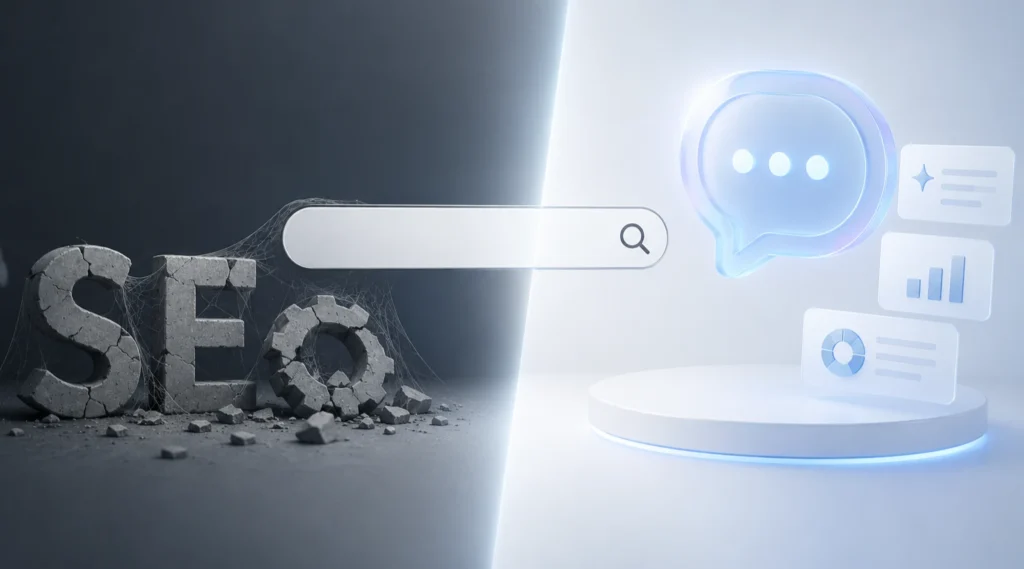
Is SEO dead? No. SEO isn’t dead in 2026, but it has changed more in the past two years than in the previous ten, and the businesses treating it like it’s 2019 are the ones whose traffic charts look like a ski slope. AI Overviews, ChatGPT, and Perplexity have rewritten how people find answers, and clicks that used to be automatic now have to be earned twice: once from the algorithm, once from the AI layer sitting on top of it. Here’s what the verified data actually shows, what still works, and where SEO is heading next.
Is SEO Dead? The Short Answer
SEO is not dead; a specific version of it is. The version that died built high volumes of generic keyword content, counted rankings and sessions as the scoreboard, and treated every click as equally valuable. What replaced it is narrower and more commercial: earning visibility where buying decisions happen, whether that’s a traditional results page, a map pack, an AI Overview citation, or a ChatGPT recommendation.
For a Toronto business owner, the practical translation is this: search is still where your next customer starts, but the work required to be found has expanded beyond rankings. The rest of this article walks through the evidence behind that answer, because on this topic, the numbers are more useful than the opinions.
Why Everyone Keeps Asking If SEO Is Dead
The question spikes every time search changes, and this cycle the change is real. Google now generates AI summaries above the traditional results for a meaningful share of queries, chat assistants answer questions that used to become searches, and business owners see the difference in their analytics. Add a wave of “SEO is dead” hot takes, and it’s no wonder the query draws thousands of searches a month.
But “dead” is the wrong diagnosis. Demand for answers hasn’t shrunk; the interface for delivering them has changed. People still search when they need a lawyer, a supplier, or a price. The businesses losing visibility aren’t victims of SEO dying. They’re running a playbook built for a results page that no longer exists. If you’re still measuring success purely by where you rank on a page of ten blue links, you’re measuring the wrong thing.
What AI Search Actually Changed: The Verified Numbers
Strip out the panic and the data tells a clear, two-sided story.
AI Overviews are significant, but not everywhere. Semrush’s study of over 10 million keywords found AI Overviews triggered on 6.49 percent of queries in January 2025, peaked near 24.61 percent in July, then settled back to 15.69 percent by November 2025. Roughly one query in six, not all of them, and concentrated in informational searches.
When AI answers appear, clicks drop. Pew Research Center tracked the real browsing behaviour of 900 US adults in March 2025 and found users clicked a traditional result on just 8 percent of searches that showed an AI summary, versus 15 percent without one. Only 1 percent of visits included a click on a link inside the summary itself. Ahrefs’ analysis of 300,000 keywords found the top-ranking page’s click-through rate was 34.5 percent lower when an AI Overview was present, and its follow-up study using December 2025 data measured the gap at 58 percent.
What that means in practice: informational traffic is being repriced. The generic top-of-funnel queries that inflated traffic reports for a decade now often end inside an AI answer. Meanwhile, commercial and local queries (the ones that produce revenue) still route real buyers to real websites. Traffic volume is down as a vanity metric; visibility where money changes hands still works the same way it always has, and now includes being the source AI engines cite.
Myth vs Reality
| Myth | What the data says |
|---|---|
| “Nobody clicks anymore” | Clicks drop when AI summaries appear (8% vs 15% of searches, per Pew Research Center), but most queries still don’t trigger one (Semrush: ~16% did in late 2025). |
| “AI Overviews are on every search” | Semrush measured 15.69% of queries triggering AI Overviews in November 2025, after a mid-year peak near 25%. |
| “Rankings don’t matter now” | Ranking pages lose share of clicks to AI answers (Ahrefs: 34.5%, later 58% on affected queries), but AI engines overwhelmingly cite pages that already rank and demonstrate authority. |
| “SEO effort is wasted” | The same fundamentals that earn rankings (authority, structure, trust) are what earn AI citations; the work compounds across both surfaces. |
What Actually Died in SEO (and What Replaced It)
Some tactics genuinely are dead, and pretending otherwise wastes budget. Publishing thin blog posts at volume to farm informational long-tail traffic is over; those are precisely the queries AI answers absorb first. Chasing keyword density, spinning near-duplicate location pages, and buying low-quality links were already decaying before AI search; now they’re liabilities. And reporting on raw sessions as the headline metric is dead too, because a falling traffic line can hide a rising revenue line when the lost clicks were never going to buy anything.
What replaced each of them is a higher standard, not a different discipline: fewer pages with more proof, structure that machines can extract, authority signals that survive verification, and reporting anchored to leads and revenue instead of visits.
What Still Works in SEO in 2026
The fundamentals didn’t die; the shortcuts did. Four things continue to earn visibility on every search surface, human or AI.
Content that demonstrates real expertise. Generic explainers are exactly what AI answers replace. First-hand experience, original data, named case studies, and clear opinions are what AI engines quote and what buyers trust. Publishing proof beats publishing volume.
Technical foundations and structure. Crawlable sites, clean heading hierarchies, direct answers near the top of the page, and structured data all determine whether machines can understand and extract your content. That’s classic on-page discipline, now with a second audience.
Local SEO. Someone searching “electrician near me” still gets a map pack, and AI assistants recommending local businesses pull from the same signals: complete profiles, reviews, and consistent information. For service businesses, local visibility remains the highest-ROI channel in search, and it’s a core part of the SEO programs we run in Toronto.
Authority you can verify. Links, mentions, and citations from credible sources still separate sources worth quoting from content worth ignoring, for Google and for language models alike. If your traffic has slid and you can’t pinpoint why, the diagnostics in our post on the signs you need professional SEO help are a practical place to start.
From SEO to AEO and GEO: Where Search Is Going
The real story of 2026 isn’t SEO’s death; it’s SEO’s merger with two new disciplines. Answer engine optimization structures your content so AI systems can extract and cite it directly, a shift we broke down in our guide to what answer engine optimization is and why it matters. Generative engine optimization goes a layer further, building the authority signals that make ChatGPT, Perplexity, and Gemini recommend your brand by name.
In practice, the work overlaps heavily: direct answers, extractable formatting, verifiable expertise, and consistent entity information feed all three. The difference is where you win: rankings, AI citations, or AI recommendations. We were among the first agencies in Canada to productize answer engine optimization and generative engine optimization as services precisely because clients kept asking the question this article answers.
The full picture of where the channel is heading, including how to get found on ChatGPT and AI Overviews, is in our 2026 SEO trends guide.
The takeaway: don’t cut the SEO budget, redeploy it. Every hour spent on authority, structure, and proof now earns visibility in two places at once.
Frequently Asked Questions
Is SEO still worth it in 2026?
Yes. Search remains a primary channel for commercial and local intent, where buyers still click through to websites, and the same optimization work now also determines whether AI engines cite and recommend you. What’s no longer worth it is volume-first content built to farm informational traffic that AI answers have absorbed.
Why do people say SEO is dead?
Because visible traffic declines are real on queries where AI summaries appear. Pew Research Center found users clicked traditional results on 8 percent of searches with an AI summary versus 15 percent without, and Ahrefs measured top-result click-through rates dropping 34.5 percent (later 58 percent) on affected queries. Those losses are concentrated in informational searches, not across all of search.
Is local SEO dead?
No, local SEO is one of the least disrupted parts of search. Map packs still appear for near-me and service queries, and AI assistants recommending local businesses draw on the same profile, review, and citation signals that local SEO builds. For service businesses, it remains the highest-converting organic channel.
Is organic SEO dead because of AI Overviews?
No, but it’s redistributed. Semrush’s 10-million-keyword study found AI Overviews triggering on about 16 percent of queries in late 2025, which leaves the majority of searches with traditional results. On affected queries, the winning move is to become a cited source inside the AI answer rather than to chase the vanishing click.
Will AI replace SEO?
AI is changing SEO rather than replacing it. AI engines need authoritative, well-structured sources to generate answers, and deciding which sources get cited is an optimization problem, now called AEO and GEO. The discipline is expanding from ranking pages to being referenced everywhere answers are generated.
SEO isn’t dead; the old scorecard is. Ready to turn your marketing into a growth engine? Claim your free 30-minute strategy session with Consultus Digital or call 416-460-1810.