A firm can buy page-one rankings, a busy Instagram account and a $10,000 monthly ad budget and still sign the same number of files it signed last year. Law firm marketing in Canada also carries a constraint most industries don’t have: every claim you publish is governed by your law society, and the rules are specific about results, rankings and testimonials. This guide covers what the channels cost in Canadian dollars, what the Law Society of Ontario permits you to say, and how to sequence the first 90 days.
What law firm marketing covers in Canada
Law firm marketing is the set of channels a firm uses to get in front of someone with a legal problem and to give them a reason to call that firm instead of the one beside it. For most Canadian firms that means six things: a website that explains the practice areas in plain language, a Google Business Profile that ranks in the local map pack, content that answers the questions clients ask before they call, paid search, a review program, and a referral network.
Those channels behave differently. How long each one takes to produce a signed file is usually what decides the order you fund them in.
| Channel | Time to first file | Who it suits |
|---|---|---|
| Google Ads | Days | Firms with intake capacity now and a high case value |
| Local SEO and Google Business Profile | 4 to 10 weeks | Firms competing for a city or neighbourhood |
| Content and organic SEO | 4 to 9 months | Firms that plan to still be here in three years |
| Reviews and reputation | Ongoing | Every firm, and it compounds |
| Legal directories | Immediate | Firms testing a new practice area |
| Referrals and PR | Months | Corporate, commercial and boutique practices |
Our law firm marketing division exists because the sequencing question is the hard part. Running all six at once is how firms end up paying for channels that were never going to close a file this quarter.
What the Law Society rules let you say
In Ontario, Rule 4.2-1 of the Rules of Professional Conduct says a lawyer may market legal services only if the marketing is demonstrably true, accurate and verifiable, is not misleading or confusing or deceptive, and is in the best interests of the public. The full wording, and the commentary that does most of the work below, sits in Chapter 4 of the Law Society of Ontario’s Rules of Professional Conduct. Alberta and British Columbia have parallel advertising rules, so confirm the version that applies to your licence before you sign off on a campaign.
Four places where firms and their agencies run into the rule:
Past results and settlement amounts
The LSO commentary flags stating an amount recovered for a client, or referring to a degree of success in past cases, unless the statement is accompanied by a further statement that past results are not necessarily indicative of future results and that outcomes vary with the facts of each case. If your ad copy carries a number, it carries that disclaimer too, including in a 30-character Google Ads headline where it does not fit. That is usually the point where a settlement-figure campaign gets rebuilt around something else.
Awards, rankings and “best of” badges
The commentary reads awards and rankings broadly, and says the terms include superlative titles such as “best”, “super” and “#1”. A badge contravenes the rule if it doesn’t reflect the lawyer’s performance and the quality of their services, if it wasn’t the result of a reasonable evaluative process, or if it was conferred partly because a fee was paid. Directory badges sold as part of a listing package are the ones worth checking. The rule asks for particular care with awards referenced in mass advertising, where a prospective client has little chance to weigh the context.
Testimonials and reviews
Ontario doesn’t ban client testimonials outright, which surprises people who work in healthcare marketing. The commentary flags testimonials or endorsements that contain emotional appeals, along with copy that suggests qualitative superiority to other lawyers, raises expectations, or implies the lawyer is aggressive. A five-star Google review posted by a client is a different thing from a scripted video testimonial written by a marketing team, and the second one is where the risk sits. Handling review generation and response properly is a reputation management discipline.
Fees, specialization and second opinions
Rule 4.2-2 permits fee advertising if the advertising is reasonably precise about the services covered, states whether disbursements, third-party charges and taxes are extra, and if the firm adheres to the advertised fee in every applicable case. Rule 4.3-1 says a lawyer shall not advertise as a specialist in a field unless certified by the Law Society, though a firm may describe preferred areas of practice and its experience in them. And Rule 4.2-1.2 prohibits the marketing of second opinion services, whatever the intent behind it.
None of this stops a firm from marketing. It moves the competitive advantage from who makes the loudest claim to who explains the process most clearly, which is a fight a smaller firm can win.
How much law firm marketing costs in Canada
Canadian firms working with an agency generally land between $3,000 and $15,000 a month across all channels, with solo and small firms at the low end and firms buying competitive personal injury traffic well above it. Scope varies enough between agencies that two quotes at the same price can describe different work, so compare deliverables before you compare numbers.
| Service | Typical monthly range (CAD) | What it usually covers |
|---|---|---|
| SEO and local SEO | $1,500 to $5,000 | Technical fixes, practice area pages, Google Business Profile, link acquisition |
| Content | $1,000 to $4,000 | Two to six pieces a month plus internal linking |
| Google Ads media spend | $2,000 to $10,000+ | The budget paid to Google, before management |
| Ads management fee | 10% to 20% of spend | Campaign build, bid management, negative keywords, reporting |
| Website build (one time) | $8,000 to $40,000 | Design, development, practice area architecture, tracking |
| Reviews and reputation | $500 to $1,500 | Request workflows, monitoring, response drafting |
Paid search is where legal gets expensive. Our Google Ads benchmarks guide, built on AgencyAnalytics data covering more than 150,000 North American campaigns, puts the legal category at a $4.96 average cost per click with a 9% conversion rate and a cost per acquisition above $60. Competitive personal injury terms in Toronto and Vancouver run several times that average, so treat the category figure as a floor for planning.
If your firm is at capacity and most of your files arrive through referrals, more marketing spend is the wrong lever. Fixing intake response times, or raising rates, will do more for revenue than a bigger ad budget, and no agency should tell you otherwise.
Which channels fit which practice area
Practice area changes the answer more than firm size does, because it changes how the client searches and how much a file is worth.
| Practice area | Where the budget goes first | Why |
|---|---|---|
| Personal injury | Paid search plus reviews | High case value carries a high click cost; trust decides the call |
| Family law | Local SEO plus content | Clients research for weeks before contacting anyone |
| Criminal defence | Local SEO plus paid search | Urgent, same-day intent, often on a phone |
| Corporate and commercial | Content, LinkedIn, referrals | Buyers are repeat clients and in-house counsel, not searchers |
| Real estate and wills | Local SEO plus fee transparency | Price-comparison intent, and Rule 4.2-2.1 governs the pricing page |
Our SEO work for legal practices and our paid media for law firms are built around that split, because a family law page and a commercial litigation page are not the same page with different words.
What AI search changed for law firm marketing in 2026
Google’s AI Overviews now answer a large share of legal research queries on the results page. Someone asking how long they have to sue after a car accident reads a synthesized answer, and the firms cited in it get the visit. That moves the target from ranking a page to being the source an answer engine quotes.
What earns a citation is closer to legal writing than to marketing copy: a direct answer in the first sentence, a named statute or limitation period, a clear author with credentials, and a page structure an engine can parse. Firms that have been publishing real explanations of process have an advantage here. Our guide to the difference between AEO and SEO covers how the two fit together and what has to change on the page.
A 90-day law firm marketing plan
- Days 1 to 30, fix the foundation. Audit every published claim against Rule 4.2. Add the past-results disclaimer or remove the figures. Claim and complete the Google Business Profile with correct practice areas, hours and photos. Install call tracking and conversion tracking so the next 60 days produce data.
- Days 31 to 60, build the pages that convert. Write or rewrite one page per practice area, each answering what the process looks like, what it costs, and how long it takes. Launch a small paid search campaign on your highest-value practice area, capped tightly, to learn the real cost per enquiry.
- Days 61 to 90, scale what worked. Shift budget to the channel that produced signed files. Start the review request workflow with closed files. Set a monthly content cadence you can hold for a year.
What to measure
Leads are a vanity metric in legal, because a personal injury enquiry and a small claims enquiry carry different economics. The number worth reporting is cost per signed file by practice area, which means intake has to record where each enquiry came from.
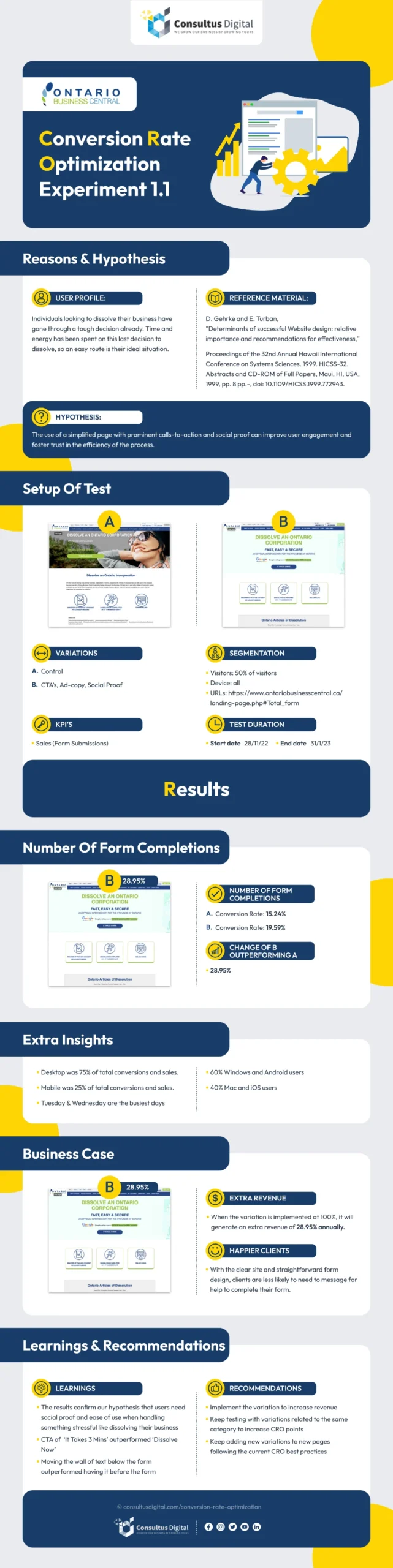
Conversion rate on the pages people land on is the second number. When Zayouna Law Firm tested a challenger landing page for its commercial litigation division, the challenger beat the baseline conversion rate by 330% and the industry average by 194% within three months, on the same traffic. Page performance is usually cheaper to fix than traffic volume.
Frequently Asked Questions
What is law firm marketing?
Law firm marketing is how a firm attracts and converts legal clients, across its website, search rankings, paid ads, content, reviews and referral relationships. It differs from general marketing because law society rules govern what a firm can claim about results, rankings and expertise. In Ontario those rules sit in Chapter 4 of the Rules of Professional Conduct.
How much should a law firm spend on marketing?
Most Canadian firms working with an agency spend between $3,000 and $15,000 a month, and a common planning benchmark is 2% to 5% of gross revenue a year. Solo and small firms often start at $1,500 to $4,000 a month. The right figure depends on average case value and how much intake capacity you have, because marketing that outruns intake wastes the spend.
How long does law firm marketing take to produce results?
Paid search can produce enquiries within days of launch. Local SEO usually moves within four to ten weeks, and organic content and rankings take four to nine months before they carry meaningful volume. Firms that need files this quarter should fund paid search first and treat SEO as the investment that lowers cost per file later.
Are client testimonials in law firm advertising allowed in Canada?
In Ontario, testimonials aren’t banned, but LSO commentary flags testimonials or endorsements that contain emotional appeals, and prohibits marketing that suggests qualitative superiority to other lawyers or raises expectations. Rules differ by province, so confirm the standard your law society applies before publishing one.
How do you market a small law firm?
A small firm wins on specificity. Pick one or two practice areas, build a page for each that explains process, cost and timelines better than the larger firms do, keep the Google Business Profile active with reviews, and run a tightly capped paid search campaign only on the terms closest to hiring intent. Competing on brand spend against a national firm is the losing version of the same plan.
What digital marketing strategies work best for law firms?
Local SEO and Google Business Profile optimization, practice area content that answers pre-hire questions, paid search on high-intent terms, and a steady review program. For corporate and commercial practices, LinkedIn and referral marketing outperform search, because those buyers rarely start with a Google query.
Marketing a firm in Canada is as much a compliance exercise as a growth one, and the firms that handle both tend to spend less to sign more. Ready to turn your marketing into a growth engine? Claim your free 30-minute strategy session with Consultus Digital or call 416-460-1810.

Brand, Social & Compliance Specialist
Grace owns the most differentiated editorial niche on the team. She is the authority on digital advertising compliance across regulated Canadian industries (healthcare, legal, real estate), while also driving expertise in influencer marketing, social media strategy, and online reputation management. Grace bridges the gap between creative brand-building and the rules that govern it.
Recommended Articles


This Month's Strategy Can Define Your Year - Don't Miss Out!

4.9 stars from 43 entrepreneurs



 416-460-1810