Why Your Healthcare Ads Keep Getting Rejected (And How to Fix Them)

Healthcare ads on Meta and Google don’t get rejected by accident; they get flagged for targeting personal health attributes, using prescription drug names, or sending sensitive patient data back to ad pixels. On top of platform rules, Canadian clinics must navigate provincial regulatory college guidelines that ban testimonials and superlatives. To run high-converting, compliant campaigns: describe your services instead of the patient’s condition, replace drug trade names with treatment categories, and audit your website tracking setup.
Healthcare marketing is high-stakes. One wrong word in a headline or a misconfigured pixel event, and suddenly your campaign is grounded, your ad account is flagged, or worse, a regulatory college comes knocking.
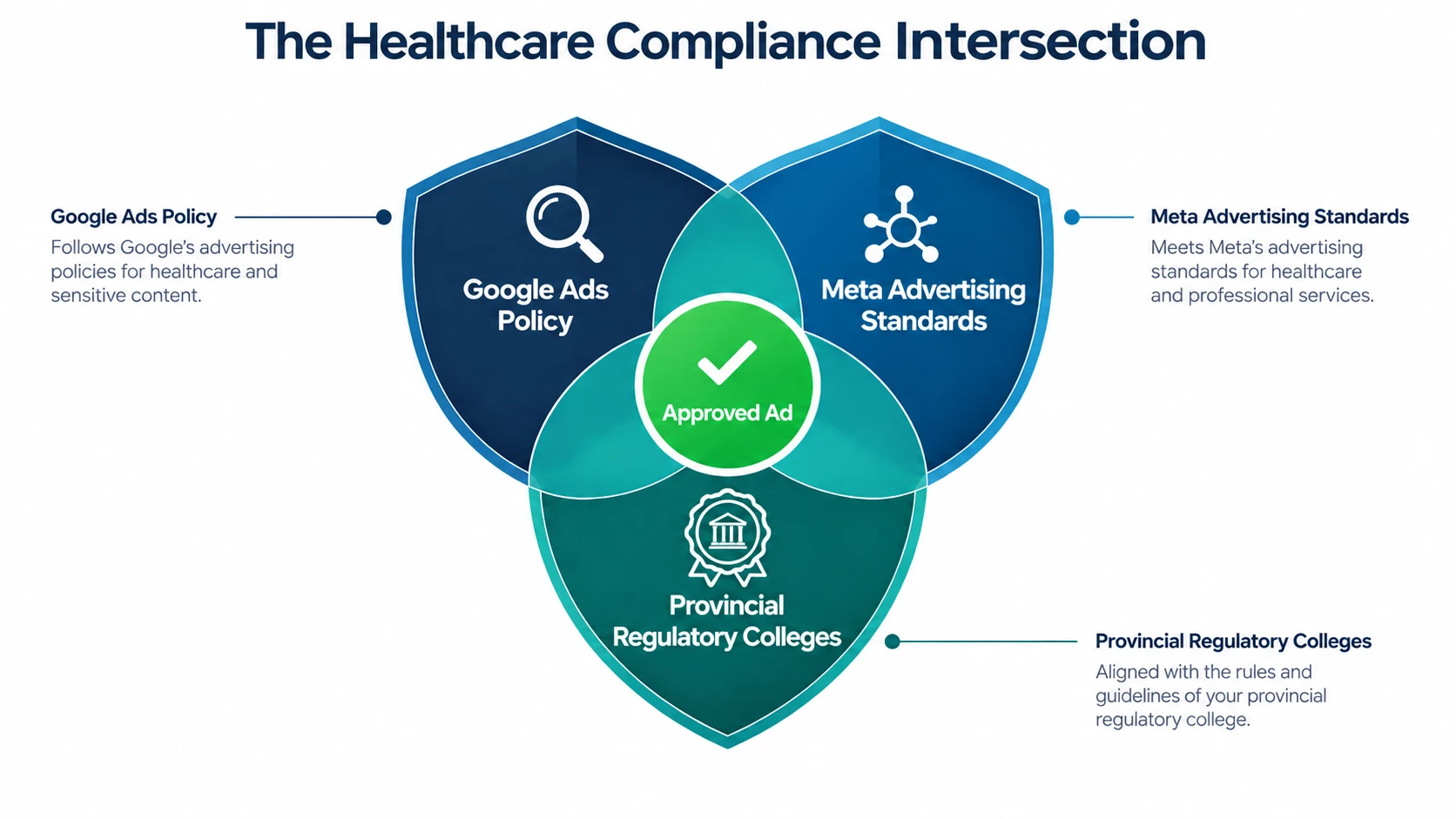
Yet, running successful, high-ROI paid campaigns for Canadian healthcare clinics, med spas, and telehealth brands is entirely doable. You just need to know how to navigate the triple threat of compliance: Google’s Policy, Meta’s Algorithm, and Provincial Regulatory Colleges.
Here is your practical guide to creating high-converting healthcare ads that actually get approved and stay online.
Why Healthcare Ads Get Flagged
Platforms don’t reject your ads to ruin your Tuesday—they do it to shield themselves from legal liability and protect user trust. Every policy violation traces back to three core principles:
- Privacy Paranoia: Pointing out someone’s medical struggle feels invasive. If your copy sounds like you peeked at their medical chart, it’s getting pulled.
- Harm Prevention: Misleading medical claims carry real-world danger. The standard of proof for healthcare messaging is massively higher than selling sneakers.
- Legal Exposure: Stricter patient-data privacy laws (PIPEDA/PHIPA in Canada) have forced tech giants to lock down health-data collection.
The Golden Rule: Anything that implies you know a user’s health condition, guarantees a medical outcome, or passes patient data back to ad networks will trigger a flag.
The Google Ads Playbook for Canadian Clinics
Google is the intent engine, and patients actively search for solutions here. But one wrong keyword can freeze your account.
Do You Need Certification?
- Standard Clinics (No Certification Needed): Physiotherapy, general dentistry, chiropractic, dermatology, and general practitioners can launch search ads immediately.
- Certification Required: Online pharmacies, prescribing telehealth providers, and pharmaceutical brands must be pre-certified by Google (often requiring LegitScript accreditation) before running ads.
The Prescription Drug Trap
Canada is one of the rare jurisdictions alongside the US and New Zealand where prescription drug names can be used promotionally under tight constraints. However, bidding on prescription brand names as keywords without Google certification will lead to instant disapprovals.
The Trap Most Marketers Fall Into: Retargeting
You cannot run remarketing campaigns based on health conditions. If a user visits your “Spinal Disc Herniation Treatment” page, you cannot follow them across the Web Display Network. Google views health-based retargeting as a major privacy violation.
3. Meta’s Rules: Two Separate Rulebooks
First, let’s kill a common myth: Healthcare is NOT a Meta Special Ad Category. Declaring it as one won’t protect you.
Meta enforces compliance through two completely separate systems:
Rulebook #1: Ad Copy & Visual Standards
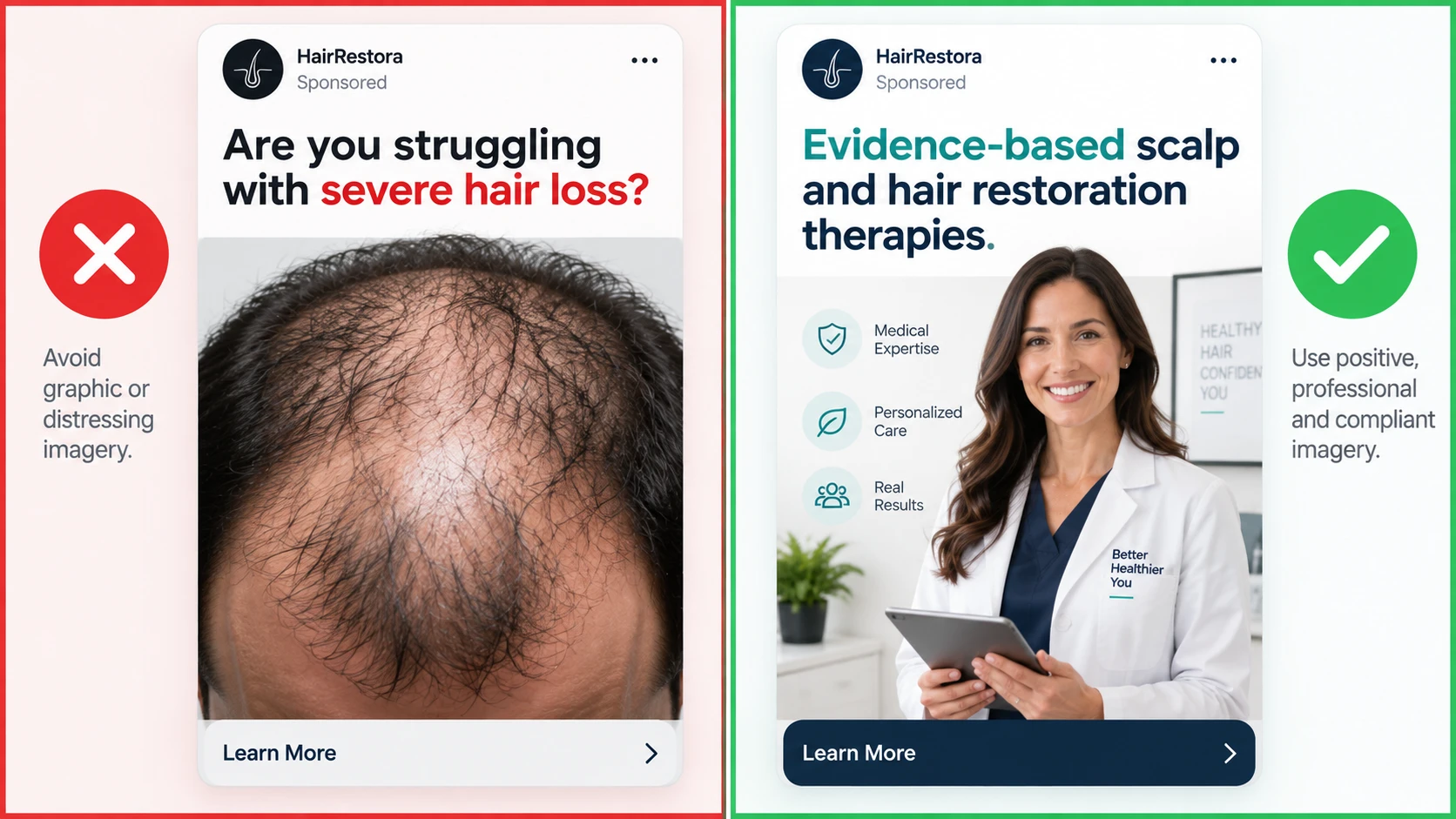
- Personal Attributes: You can’t speak directly to a user’s health status. Asking “Are you struggling with depression?” will be rejected. Framing it as a service: “Our Toronto practice offers evidence-based depression therapy” passes.
- Sensational / Triggering Creative: Close-ups of skin conditions, dramatic before-and-after photos, or imagery targeting body insecurity are rejection magnets.
- Rx Brand Names: Dropping names like Botox or Ozempic triggers automated pharmaceutical policies. Stick to generic categories like “cosmetic injectables” or “medical weight management.”
Rulebook #2: Domain-Level Pixel Restrictions
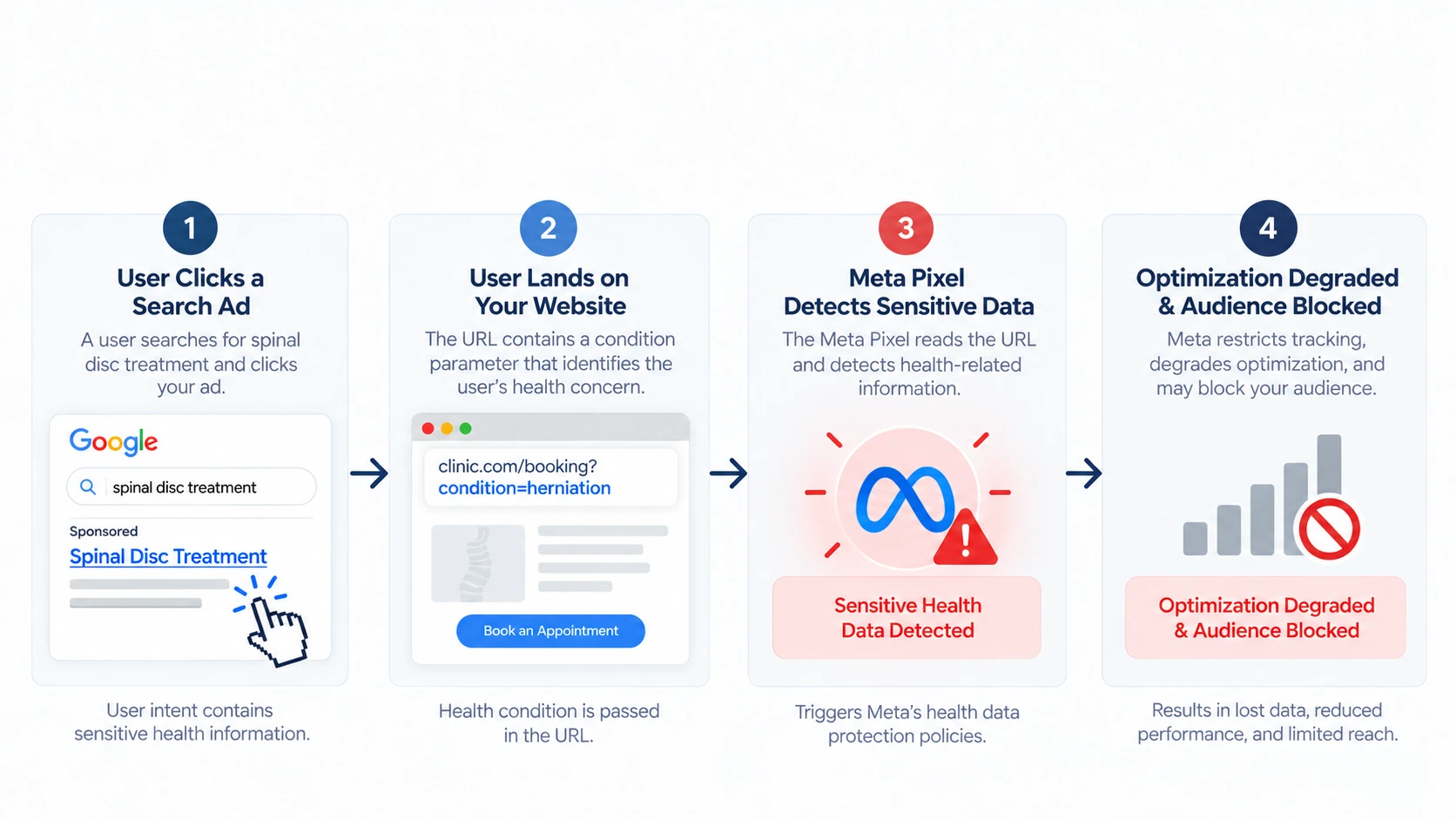
Your ad copy might pass inspection, but your tracking setup can still break in the background. Meta actively scans landing page domains for health content.
If your domain gets classified under Meta’s health restrictions:
- Meta may block lower-funnel pixel events (Lead, Schedule, Purchase).
- Conversion-optimized campaigns will lose performance signal.
- Custom audience builds based on website URL visits will shrink or fail.
The Hidden Boss: Your Provincial Regulatory College
Even if Meta and Google approve your campaign, your provincial regulatory college can still penalize the clinic. Platforms enforce ad policy; colleges enforce professional conduct.
If a practitioner’s name (MD, DDS, NP, PT) is attached to the brand, you must comply with their governing body (e.g., CPSO, RCDSO, CPO):
- No Patient Testimonials: Bodies like the College of Physicians and Surgeons of Ontario (CPSO) prohibit patient reviews in practitioner advertising.
- No Superlatives: Claiming to be the “Best Cosmetic Dentist in Vancouver” can be classified as professional misconduct.
- No Unsolicited Before/After Feed Images: Paid social ads are considered unsolicited. Place galleries on your website where users must explicitly click to view.
Real-World Copy Translations
Converting non-compliant draft ideas into high-converting, policy-cleared copy relies on shifting focus from the reader’s condition to your clinic’s services and credentials.
Here’s how to take non-compliant copy and turn it into approved, high-converting messaging:
| Non-Compliant Framing (High Rejection Risk) | Compliant Alternative (Approved Framing) | Primary Policy Reason |
|---|---|---|
| “Do you suffer from chronic migraines?” | “Our clinic provides specialized management programs for chronic migraines.” | Avoids Meta Personal Attributes violation. |
| “Book your Botox appointment today – $10/unit!” | “Consultations for custom cosmetic injectable treatments.” | Removes prescription trade name and promotional pricing. |
| “Rated the #1 clinic in Vancouver! Guaranteed permanent relief.” | “Licensed practitioners delivering evidence-based care in Vancouver.” | Eliminates superlatives, cure claims, and college testimonial conflicts. |
Pre-Launch Compliance Checklist
Run every healthcare campaign through this 8-point inspection before hitting publish:
- Licensure Check: Is geo-targeting strictly mapped to the provinces where your clinicians are registered?
- Copy Audit: Did you strip out all second-person condition questions (“Do you have…?”)?
- Rx Brand Removal: Are drug trade names replaced with service categories?
- Visual Review: Are before-and-afters or visceral close-up shots removed from ad creatives?
- College Alignment: Does the copy respect provincial governing rules (no testimonials or superlatives where restricted)?
- Pixel Hygiene: Are sensitive health parameters (like diagnosis names or booking confirmation details) excluded from URL parameters passed to pixels?
- Age Gating: Are prescription-adjacent or cosmetic procedure campaigns set to 18+?
- Landing Page Consistency: Does the destination page mirror the compliant language used in the ad?
What to Do When Your Ad Gets Rejected
Don’t panic, and definitely don’t repeatedly resubmit the exact same ad without edits; that’s a fast track to account suspension.
- Identify the Real Trigger: Check the exact policy cited in the notice. Often, the trigger lives on the landing page, not the ad creative.
- Make the Edit: Adjust the copy, image, or URL structure to meet compliance.
- Submit One Clear Appeal: Explain the change briefly and request re-review.
- Domain Classification Issues: If Meta locks down conversion tracking, use Meta Lead Forms or shift primary optimization targets to top-of-funnel events (Landing Page View) while relying on first-party CRM data for actual conversion tracking.
Compliance Is Your Competitive Advantage
Navigating healthcare advertising in Canada can feel like walking through a regulatory minefield, but compliance doesn’t have to kill your campaign performance.
The marketers and clinic owners who succeed aren’t the ones trying to sneak unapproved claims past Meta’s algorithm or Google’s review system. They’re the ones who build sustainable, policy-cleared acquisition engines that run smoothly without the constant threat of ad disapprovals, pixel blocks, or college warnings.
By shifting your ad copy from reader conditions to clinical expertise, keeping your pixel hygiene clean, and aligning with provincial standards, you protect your ad account and build real patient trust.