



+2,900%
ROAS increase of 2,900% in addition to a 33% CTR increase.
A/B and multivariate testing run as a discipline rather than a tool. Hypothesis backlog, statistical rigor, and an experiment archive that compounds across quarters instead of dying with the latest test.

ROAS increase of 2,900% in addition to a 33% CTR increase.

Harmony Resorts reported a 6% conversion rate and an increase in ROAS of 74%.

A 41% increase in revenue along with an efficient 16% increase in ROAS.

From zero to $420K in online sales within 10 months.
Experimentation programs that compound. Split testing held to real statistical significance, not screenshots of a two-day test that happened to look good.
A backlog built from evidence, tests run to a sample size agreed before they start, and every result written up whichever way it goes. Cross-functional learnings that carry across quarters instead of leaving with the person who ran them.
Your traffic sets the pace, not us, and the arithmetic is simple. A single test usually needs two to four weeks to reach a trustworthy sample, so a realistic first quarter is three or four completed experiments, not thirty. Sites under roughly a thousand conversions a month should expect fewer and longer tests, and we’ll tell you that before you sign rather than after the first inconclusive month.

Well-designed tests that beat the control
Time to reach a trustworthy sample
Conversions a month for tests that resolve
Completed experiments, not thirty
Sample sizeFIXED FIRST
Stopping ruleNO PEEKING
WinnersSHIPPED
Six things separate a testing program that compounds from one that produces confident reports and no measurable change.
Every experiment starts as a written prediction with evidence behind it and a number attached. Ideas get scored on expected impact, available traffic, and build effort. Low-traffic pages sequence last, not because the idea is weak but because it can’t be settled. The backlog also does something political: it turns internal disagreement into a queue.
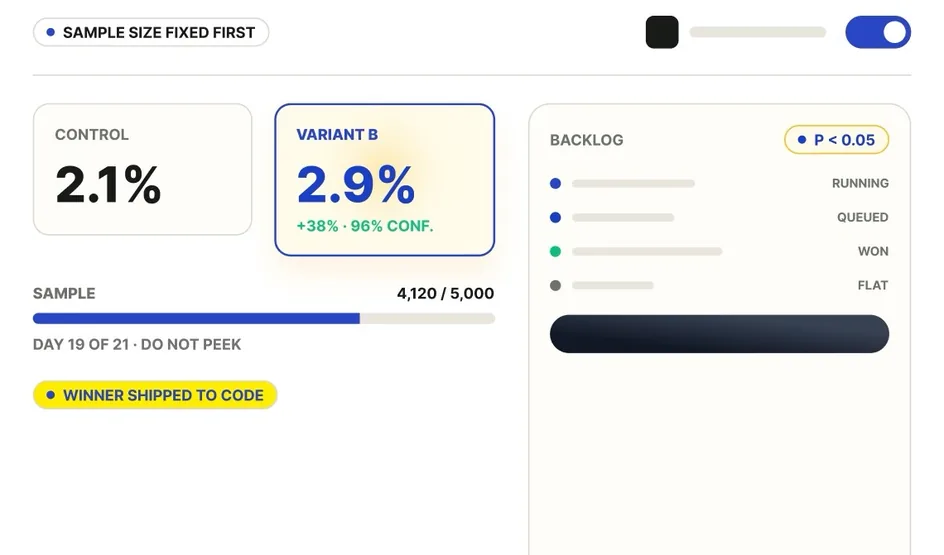
The sample size and threshold are fixed before the test starts, then honored. Tests run through at least one full business cycle so a Tuesday pattern doesn’t decide anything, and we don’t stop early because a variant is ahead. We also account for running several tests at once, because the more you run, the more likely one looks significant by chance.
Button colors are easy to ship and almost always flat. If a hypothesis couldn’t plausibly move the number by a few points, it isn’t worth a month of traffic. The candidates that earn a slot are offers, pricing presentation, form length, the order of a multi-step flow, and the argument the page makes.
Roughly two thirds of well-designed tests don’t win, and that is what a real program looks like. A loss is a finding: it tells you something true about your buyers you would otherwise have shipped as a redesign. Any agency reporting a near-perfect win rate is either testing trivia or calling results early.
The tests end. What you learned should not have to be relearned. Every experiment goes into a log with its hypothesis, setup, result, and implication. That archive is worth more than any single uplift, and it is the deliverable that survives a change of agency, which is rather the point.
A variant left running in a testing tool forever is technical debt with a monthly fee. Winners get built into the codebase properly and finished tests get removed. If engineering can’t absorb winners, the program has an expiry date and we would rather discuss that up front.
Four stages, each with something you keep whether or not we keep running the program.
Evidence in, ideas ranked.
Analytics, session replay, form analytics, and what your sales and support teams already know, turned into predictions scored on impact, available traffic, and effort. You keep the backlog whether or not we run the tests.
Sample size before build.
Each test gets its duration, threshold, and success metric agreed in advance, plus a check that the tracking can actually measure the thing being claimed.
To completion, without peeking.
Tests run their full course through at least one business cycle. We report progress without acting on partial results, because acting on them is the same as not testing.
Write it up, ship it, log it.
Winners into the codebase, finished tests removed, and every outcome including the losses recorded with what it implies for the next round.
A program can report a year of wins while nothing moves in the accounts. These are the numbers that catch it.
The share of tests that beat the control. Around a third is healthy. A win rate near 100% means the tests are trivial or being called early, and it is the fastest way to spot a program performing instead of measuring.

How many tests changed a decision, win or lose. The better measure of a program’s worth. A well-designed loss that stops an expensive redesign is worth more than a marginal win.

Not conversion rate on its own. Discount hard enough and conversion rate climbs while revenue falls. This is the metric that catches a test winning while the business loses.

How long a decision takes at your volume. It sets the honest pace of the whole program and stops impatience turning into early calls.

Whether a win still shows up a quarter later. Some uplifts are novelty effects that fade. We re-check the big ones so the total we report matches what the accounts show.

How many results are live in the codebase rather than the testing tool. The step that turns a result into money, and the most common place value leaks out of these programs.
Monthly conversions decide how many tests a program can settle. Work that number out before planning one.

You keep the backlog and the archive either way, which is what stops the same questions being relitigated a year later. Where volume is the limit we lead with conversion research and purpose-built pages, which produce more at lower traffic.
Every one of these produces confident reporting and no measurable change.

A variant up 40% after 200 sessions is noise. Stopping there feels decisive and generates uplifts that never appear in revenue. The sample size has to be fixed first and honored.

Colors, minor copy tweaks, and shuffling elements. Cheap to run, almost always flat, and they consume the traffic a real experiment needed.

Run twenty tests and one will look significant by chance. Programs that never mention this are accumulating false positives and calling them a track record.

Chasing conversion rate while revenue per visitor falls, or lead volume while lead quality collapses. The test wins, the business does not.
Results left in the testing tool, slowing the page and eventually breaking. The value of a test is only realized when it is deployed.

Without a log, the same questions get re-tested every eighteen months as people change, and each new team spends its first quarter rediscovering what was already known.
Testing settles the expensive arguments. Research finds the obvious problems without needing an experiment. A purpose-built page is the bigger swing.
The most rigorous option and the most traffic-hungry. Worth it when the decision is expensive and the volume can prove it, and wasteful when neither is true.
Research, form analytics, and replay find problems that don’t need an experiment to confirm. This is where lower-volume sites should start.
When the current page is aimed at the wrong buyer, testing tweaks to it wastes months. Building a purpose-built alternative is the larger and faster move.
These usually run as one program. Conversion work generates the hypotheses, testing settles the expensive ones, and new landing pages take the bigger swings. Findings feed back into Google Ads and Meta Ads, because a winning argument on a page is usually a winning argument in an ad.
Experimentation compounds when it plugs into the rest of the program. Here is what it pairs with.
Conversion research generates the hypotheses worth testing, and finds the problems obvious enough that spending traffic to confirm them would be waste.
Winners have to reach the codebase to be worth anything. Development capacity is usually the constraint that decides whether a program keeps paying.
Purpose-built pages give us somewhere to test offers and arguments without touching the main site, which lowers both the risk and the release overhead.
You can only test what you can measure. Clean tracking is the precondition for a result anyone should act on.
The offers and arguments that win on a page become the next round of ad copy, and ad results feed new hypotheses back into the backlog. Findings travel in both directions once the archive exists.
There’s a reason businesses across Toronto keep working with Consultus Digital.

My firm, KASE Insurance Inc., has partnered with Consultus Digital two years ago. At that time we had no online strategy. The team have helped us rebuild our website and created an SEO strategy that has provided us with 150% ROI! Consultus Digital has an amazing customer service team and they truly care about their clients and delivering on their promises. I strongly recommend the Consultus Digital team to all my friends and clients.
 Google review
The team at Consultus Digital won our business due to their thorough assessment and realignment of our digital sales and marketing strategy. Within only a few weeks of partnering with them, we increased our inbound leads significantly by reconfiguring the user experience of our website.
 Case study
I began using Consultus Digital in January of 2022 after being with a competitor for many years. The team at Consultus Digital has helped us to increase revenues over the last number of months and has brought new engaging ideas to increase our exposure within our market. They are a great team who do amazing SEO, Google ads and CRO. Highly recommend.
 Case study
Such a great team to work with! Created an amazing new website for us along with managing all our paid digital ads each month.
 Client quote
As the VP of both Sales and Marketing for one of Canada’s largest electronic recycling companies, I wear many hats. I rely on the team at Consultus Digital to act as my outsourced, internal marketing team. Over the past 3 years, they’ve provided our company everything from website development to social media management. I would highly recommend the team at Consultus Digital to any business looking for a partner in navigating the complex world of digital.
 Client quote
Consultus Digital has looked after our website, search, social and paid media since 2021. What sets them apart is that they care about what happens after the lead comes in, not just how many come in. When something needs attention, they’re on it.
 Client quote
Working with Consultus Digital over the last year has allowed us to scale our online business significantly. We’ve learned so much in the short time working with them about our business that we’ve not only been able to apply to our digital marketing efforts but other aspects of our business. We continue to be impressed with their new innovative way of thinking in the search space, which included one of the best digital reporting dashboards I’ve seen in 17 years of digital marketing.
 Case study
Extremely happy with the overall experience working with Consultus Digital. I had the pleasure of working with Mo. Everything Mo said he was going to do, he did! We worked with Consultus Digital on a new website. Mo and the team brought our website from 2012 into 2024. Mo offered suggestions on the ways customers interact with websites, what works well, what doesn’t work well and ultimately we ended up with a very professional modern website. I would 100% recommend the Consultus Digital team!
 Google review
As a working floor, around a thousand conversions a month gives you tests that resolve in a sensible timeframe. Below that, tests either run for months or need effects so large they are rare. Where that is the case we lead with research-led conversion work, which produces results at lower volume.
Until it reaches the sample size calculated before it started, and never less than one full business cycle so a weekday or payday pattern doesn’t decide it. Usually two to four weeks. Fixing the sample size in advance and not stopping early protects more programs than any other single habit.
Around a third of well-designed tests winning is healthy. If an agency reports that most of their tests win, the tests are either trivial or being called early. Both produce reports full of uplifts and no visible change in revenue.
A legitimate and common outcome, usually meaning the change was too small to matter at your traffic level. That is itself a finding. The mistake is declaring a narrow lead a winner because a decision is wanted.
Whichever you already have, in most cases. The discipline matters far more than the platform. What we do care about is that the tool doesn’t visibly flicker before showing the variant, that finished tests get removed, and that conversion data connects to your CRM.
It can, mostly through implementation. Client-side tools add a script that can delay rendering, and leaving dozens of finished experiments running compounds it. Avoid cloaking, keep tests time-limited, use proper canonicals when serving separate URLs, and remove finished tests.
You can, and it will tell you whether the new version is better without telling you why. A reasonable trade if the decision is simply go or no-go, and a poor one if you want to learn. Where a redesign is already committed we would rather test it as a whole than not test it at all.
The backlog does, scored on expected impact, available traffic, and build effort. That matters politically as much as methodologically. You keep the backlog either way, so if we part company the reasoning doesn’t leave with us.
We re-check the significant ones, because some uplifts are novelty effects and some were false positives from running many tests at once. Most agencies skip it because it is unflattering, which is why cumulative claimed uplift across the industry usually exceeds any change visible in real accounts.
At the end of an engagement you get the shipped winners in your codebase and the archive: every experiment with its hypothesis, setup, result, and implication. The archive is the part clients underrate and the part that keeps paying, because it stops the next team relitigating settled questions and it usually reshapes ad copy and sales conversations well beyond the website.
Before you commit to a program, we’ll work out what your traffic can actually prove. Send us your monthly conversions and we’ll tell you how many tests they can settle.


